
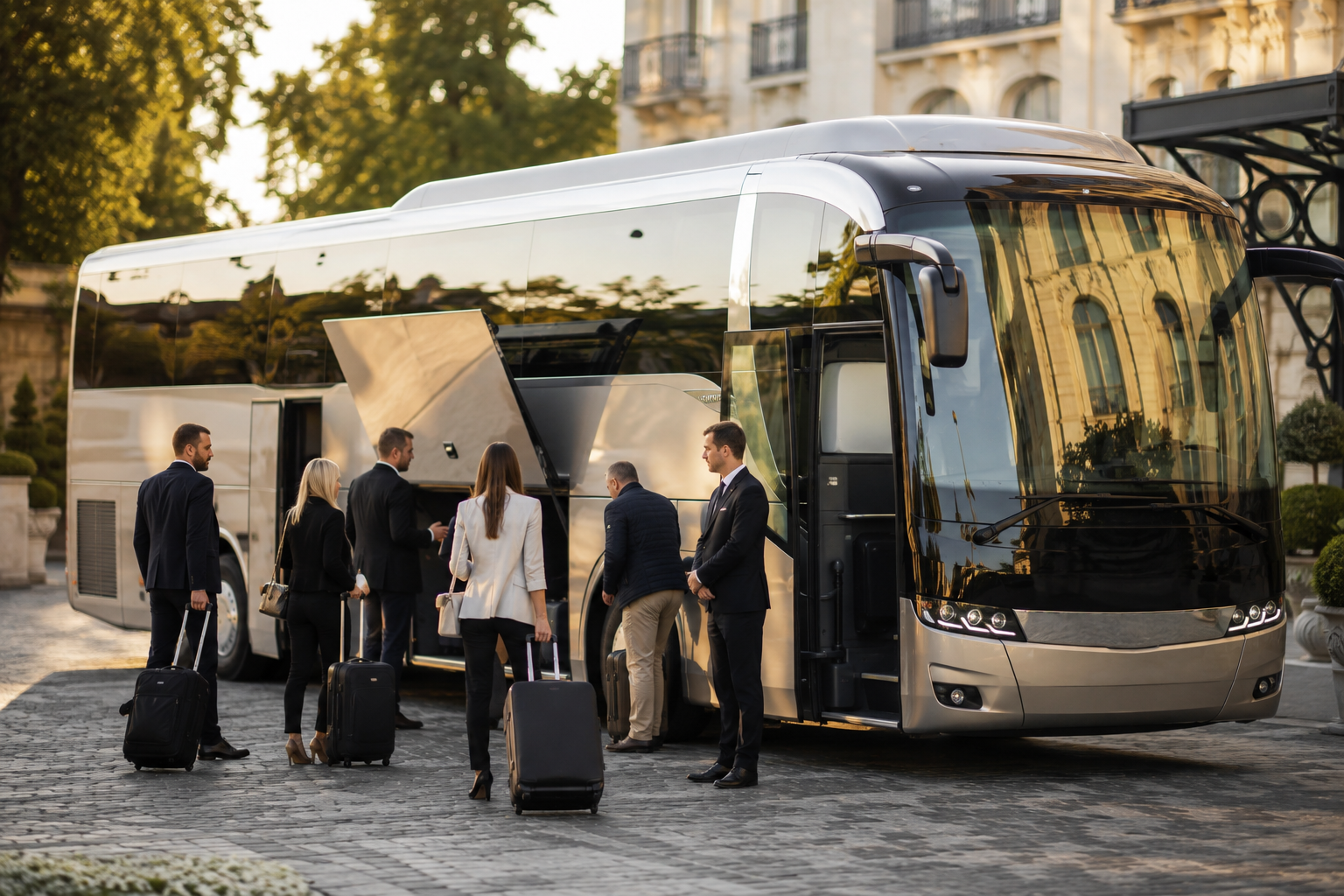
Organising group tour transport in Europe requires careful planning, especially when an itinerary includes multiple cities, countries, hotels and sightseeing destinations. Travel agents, tour operators, destination management companies (DMCs) and corporate planners need transportation that matches their passenger numbers, luggage requirements, schedules and travel routes.
Unlike individual travel, group transportation involves coordinating several passengers at the same time. Airport arrivals, hotel pickups, sightseeing movements, intercity transfers and departure arrangements must work together to keep the itinerary organised.
Group Tour Transport Europe can include private coaches, buses, Mercedes Sprinter vehicles, luxury vans, chauffeur-driven vehicles and coordinated airport transfers. The appropriate option depends on group size, journey distance, luggage volume, destination and the level of flexibility required.
For travel professionals, selecting a suitable European transportation provider is an important part of building a reliable tour programme. This guide explains the available transportation options, vehicle capacities, planning considerations and practical steps involved in arranging group transportation across Europe.
What Is Group Tour Transport in Europe?
Group tour transport in Europe refers to organised passenger transportation for travellers visiting European destinations together. It includes scheduled and private vehicle arrangements for sightseeing, airport transfers, hotel movements, intercity journeys, cruise transfers, corporate events and multi-country itineraries.
Transportation may be arranged for a single day, a city tour, a complete holiday or an itinerary covering several European countries.
Common examples include:
- Airport transfers for an arriving tour group.
- Private coach transportation for sightseeing.
- Hotel-to-hotel transfers between European cities.
- Group transportation for guided tours.
- Coach hire for educational and student groups.
- Luxury transportation for private travel groups.
- Corporate and MICE transportation.
- Cruise port transfers.
- Multi-country road transportation.
For example, a tour operator organising a France, Switzerland and Italy itinerary may require airport pickups in Paris, group transfers to Swiss destinations, transportation between Italian cities and a final airport transfer in Rome.
Each movement needs to be planned according to the itinerary, passenger count and operating arrangements.
Why Is Professional Group Tour Transport Important?
Transportation affects the timing and organisation of an entire group itinerary. If vehicles are unsuitable, pickups are poorly coordinated or luggage capacity is insufficient, even a well-planned sightseeing programme can become difficult to manage.
1. Keeping the Group Together
Using an appropriately sized private coach or vehicle can allow passengers to travel together rather than coordinating several independent taxis.
This is particularly useful for:
- Organised sightseeing groups.
- School and university tours.
- Corporate delegations.
- Family and private group holidays.
- Religious and cultural tours.
- Incentive travel programmes.
Keeping passengers together can simplify pickup arrangements and reduce the number of separate transportation movements.
2. Coordinating Multiple Pickup and Drop-Off Points
Group tours frequently involve several pickup locations.
For example, passengers may arrive on different flights, stay at different hotels or join a sightseeing programme from designated meeting points.
Transportation planning should establish:
- Exact pickup addresses.
- Passenger collection order.
- Scheduled departure times.
- Expected passenger waiting time.
- Final drop-off locations.
- Contact arrangements for the group coordinator.
This information should be finalised before the transportation service begins.
3. Managing Luggage and Passenger Capacity
Passenger capacity alone does not determine whether a vehicle is suitable.
A group of 16 passengers travelling with large suitcases may have different requirements from 16 passengers travelling on a short city excursion without luggage.
The quotation request should therefore include both passenger numbers and luggage details.
4. Supporting Multi-City and Multi-Country Itineraries
A European group tour may involve transportation across several destinations.
The transport provider needs to understand the complete route, including:
- Starting and ending locations.
- Intermediate destinations.
- Hotel addresses.
- Sightseeing stops.
- Border crossings where applicable.
- Driver schedules and rest requirements.
- Overnight arrangements and operational restrictions.
This is particularly important for longer coach itineraries, where driver working-time regulations affect route planning.
Types of Group Transportation Available in Europe
Different transportation options serve different passenger requirements. A private coach may be suitable for a large sightseeing group, while smaller vehicles can be more practical for families or VIP passengers.
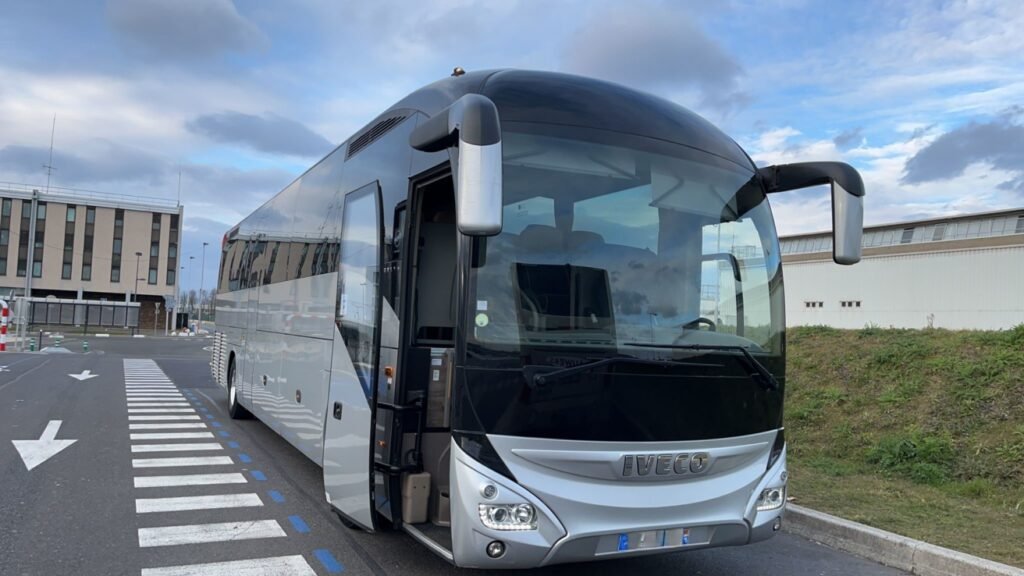
1. Private Coach Hire
Private coach hire is commonly considered for organised groups travelling together.
Coaches can support:
- Multi-day European tours.
- City sightseeing programmes.
- Intercity transfers.
- Airport-to-hotel group movements.
- Corporate events and conferences.
- Educational and student travel.
- Cruise excursions.
The main advantage is that the group can travel together according to an agreed transportation schedule.
When selecting a coach, consider passenger capacity, luggage storage, route restrictions, boarding arrangements and the duration of the service.
2. Mercedes Sprinter Transportation
Mercedes Sprinter configurations can be suitable for medium-sized groups that need more capacity than a standard passenger van.
Tour Passion’s available configurations include 12-seat, 16-seat and 19-seat Sprinter options.
These vehicles may be considered for:
- Small tour groups.
- Family groups.
- Airport transfers.
- Private sightseeing.
- Business delegations.
- Hotel-to-hotel transportation.
The exact configuration and luggage capacity should be confirmed for the required destination and date.
3. Mercedes V-Class and Luxury Van Transportation
A Mercedes V-Class can accommodate up to eight passengers according to the stated vehicle configuration.
It may be suitable for:
- Small private groups.
- Families.
- VIP travellers.
- Executive transportation.
- Airport transfers.
- Private intercity journeys.
However, luggage requirements should be checked before confirming a booking.
4. Sedan and Chauffeur Services
Sedan transportation is more appropriate for smaller passenger requirements, such as executive travel, individual airport transfers and private chauffeur arrangements.
For a large group, multiple sedans may be necessary, but this requires coordination of pickup times, vehicle assignments and passenger distribution.
5. Double-Decker and Larger Group Coaches
Larger coaches and double-decker configurations may be considered for high-capacity group movements.
They can be relevant for:
- Large tour operator groups.
- Conferences and exhibitions.
- Sports delegations.
- Educational groups.
- Large-scale sightseeing programmes.
Vehicle availability, passenger capacity, luggage storage and local access restrictions must be confirmed before booking.
Which Vehicle Is Suitable for Your Group Size?
Selecting a vehicle for group tour transport in Europe requires more than matching the number of passengers to the advertised seating capacity.
The following table provides an initial guide based on Tour Passion’s stated vehicle categories.
| Group Size | Possible Vehicle | Important Consideration |
|---|---|---|
| 1–2 passengers | Sedan | Luggage and passenger requirements |
| Up to 8 passengers | Mercedes V-Class | Confirm luggage space |
| 9–12 passengers | Sprinter configuration or multiple vehicles | Confirm exact seating configuration |
| 13–16 passengers | 16-seat Sprinter | Luggage and seating configuration |
| 17–19 passengers | 19-seat Sprinter | Confirm actual passenger and luggage capacity |
| Approximately 48–57 passengers | Large private coach | Coach configuration and luggage |
| Approximately 58–67 passengers | Larger coach configuration | Confirm local vehicle availability |
| Larger group requirements | Double-decker coach | Confirm route and access suitability |
These are indicative categories, not guaranteed vehicle allocations.
A transportation provider should confirm the exact vehicle according to the destination, group size, luggage volume, journey requirements and local availability.
For particularly large groups, using multiple vehicles may be more practical than relying on one high-capacity coach.
Group Tour Transport Across Popular European Destinations
Transportation requirements vary between European cities. Narrow historic streets, restricted access zones, airport layouts, hotel entrances and intercity distances can influence the choice of vehicle and pickup arrangements.
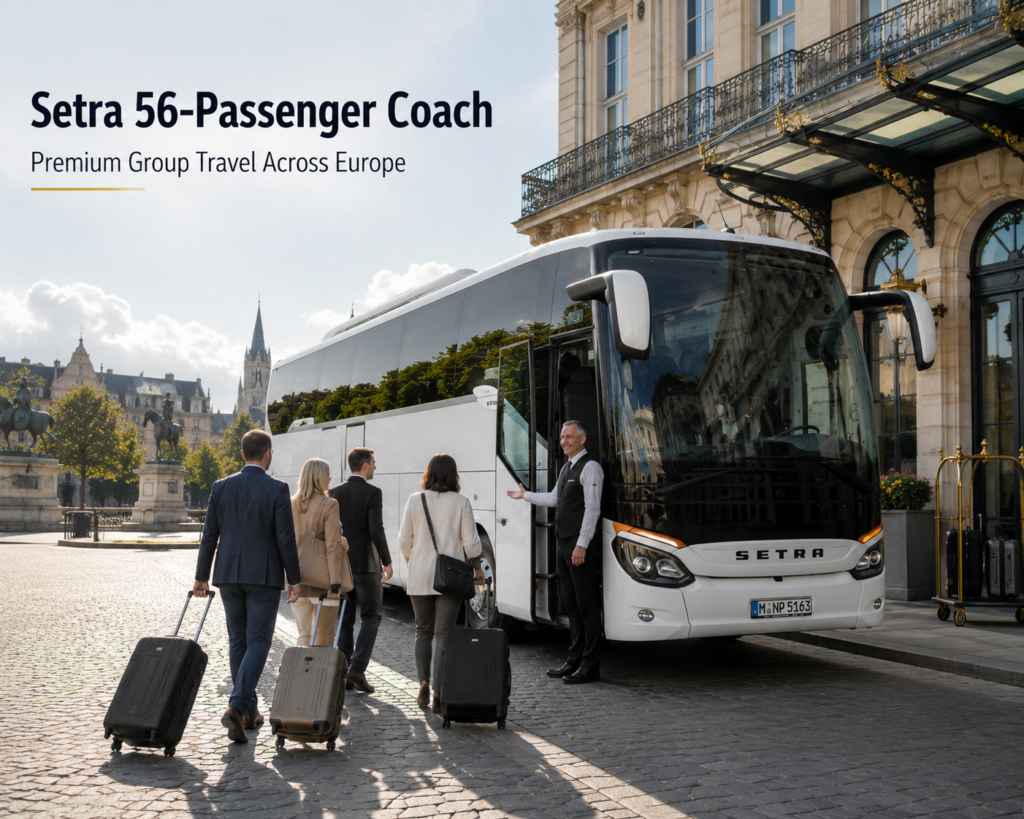
1. Group Transportation in France
France is a common destination for organised European tours.
Paris is frequently included in multi-city itineraries, while destinations such as Lyon, Nice, Bordeaux and other regional locations may require additional transportation planning.
Group transport requirements can include:
- Charles de Gaulle Airport and Orly Airport transfers.
- Hotel-to-hotel transportation.
- Private Paris sightseeing services.
- Intercity coach movements.
- Corporate and event transportation.
For groups staying in central Paris, the coach meeting point and hotel access arrangements should be checked in advance. Larger vehicles may not be able to access every street or hotel entrance.
2. Group Transportation in Switzerland
Swiss group transportation often involves city transfers and journeys to mountain or lake destinations.
Common itinerary locations include Zurich, Lucerne, Interlaken, Geneva and other regional destinations.
Planning considerations include:
- Passenger and luggage requirements.
- Hotel access.
- Mountain destination connections.
- Seasonal road conditions.
- Weather-related itinerary changes.
- Additional time for scenic stops.
When planning a Swiss group itinerary, transportation should be coordinated with sightseeing schedules and any separately booked mountain excursions.
3. Group Transportation in Italy
Italy combines major cities, historic centres and regional travel routes.
Group itineraries may include Rome, Florence, Venice, Milan, Naples and other destinations.
Important considerations include:
- Historic city access restrictions.
- Coach parking and permitted stopping points.
- Hotel pickup arrangements.
- Intercity travel distances.
- Luggage capacity.
- Sightseeing and transfer schedules.
Some historic city centres have restricted traffic zones. Tour operators should verify the relevant access and drop-off arrangements before confirming the route.
4. Group Transportation in Germany
Germany is relevant for city tours, business travel, exhibitions and multi-country European itineraries.
Group transportation may involve Berlin, Munich, Frankfurt, Hamburg and other destinations.
Travel planners should consider airport transfers, exhibition venue access, hotel locations and intercity route requirements.
5. Group Transportation in Spain
Spain offers several group travel destinations, including Barcelona, Madrid, Valencia and Seville.
Transportation arrangements may include airport transfers, sightseeing, hotel movements, cruise transfers and intercity journeys.
For groups arriving at Barcelona-El Prat Airport or Madrid-Barajas Airport, pickup instructions should identify the correct terminal and meeting point.
6. Group Transportation in the Netherlands and Belgium
Amsterdam, Brussels, Bruges, Rotterdam and other destinations can form part of Western European group tours.
When arranging transportation, check:
- Coach access to central areas.
- Designated passenger pickup locations.
- Hotel loading and unloading facilities.
- Parking and waiting arrangements.
- Connections with rail stations and airports.
These details help avoid unnecessary delays during organised group movements.
Private Coach vs Multiple Smaller Vehicles: Which Is Better?
Choosing between a private coach and multiple smaller vehicles depends on the itinerary and the group’s requirements.
| Planning Factor | Private Coach | Multiple Smaller Vehicles |
|---|---|---|
| Group coordination | One main vehicle movement | Several vehicle movements |
| Passenger distribution | Group travels together | Passengers divided between vehicles |
| Luggage | Depends on coach configuration | Depends on each vehicle |
| Narrow street access | May be restricted | Smaller vehicles may be easier to accommodate |
| VIP flexibility | Less individual flexibility | More flexibility for separate movements |
| Large group sightseeing | Often practical | Requires additional coordination |
| Airport transfers | Suitable for coordinated arrivals | Useful for staggered arrivals |
A private coach can be a practical choice when the entire group follows the same schedule.
Multiple smaller vehicles may be more appropriate when passengers arrive at different times, stay at different hotels or require separate pickup arrangements.
For example, a 30-person corporate delegation arriving on several flights may benefit from a coordinated transfer plan using multiple vehicles instead of waiting for every passenger to arrive before departing in one coach.
How to Plan Group Tour Transport Across Multiple European Countries
A multi-country itinerary requires more coordination than a single-city transfer.
Travel agents and tour operators should plan the transportation route alongside the hotel and sightseeing schedule.
Step 1: Finalise the Travel Route
Prepare a list of all destinations in the correct order.
For example:
Paris → Brussels → Amsterdam → Frankfurt → Munich → Zurich.
This is only an illustrative route. The actual itinerary should be evaluated for geographical practicality, journey requirements and the amount of time available.
Step 2: Confirm Passenger Numbers
The final passenger count helps determine the appropriate vehicle configuration.
If the group size is not final, provide an estimated number and request confirmation of how changes may affect the quotation.
Step 3: Prepare Luggage Information
Provide:
- Number of suitcases.
- Approximate suitcase sizes.
- Number of cabin bags.
- Special equipment or oversized luggage.
- Any additional baggage requirements.
This is particularly important when choosing smaller vehicles.
Step 4: Share Hotel and Airport Details
Provide complete pickup and drop-off addresses.
For airport services, include flight numbers, arrival dates, scheduled arrival times, terminal information where available and passenger contact details.
Step 5: Plan Driver Schedules and Journey Breaks
Long-distance coach transportation must account for applicable driver working-time, driving-time and rest-period rules.
Under the general EU rules applicable to covered bus and coach operations, driving time is normally limited to nine hours per day, with extensions to ten hours permitted twice per week. Drivers must also take the required breaks and rest periods.
This means a long itinerary cannot simply be planned around passenger preferences. The route and schedule must also comply with the applicable regulations.
Step 6: Confirm Border and Route Requirements
When travelling across countries, confirm the relevant operator documentation, route permissions and local requirements.
International occasional coach services within the EU are subject to specific rules under Regulation (EC) No 1073/2009.
Travellers should also check their own entry and visa requirements where relevant.
Step 7: Establish a Contingency Plan
Travel agents should consider possible disruptions such as:
- Flight delays.
- Road congestion.
- Weather conditions.
- Changes to passenger numbers.
- Hotel access restrictions.
- Missed connections.
- Changes to sightseeing schedules.
A designated group coordinator and clear communication arrangements can help manage unexpected changes.
Important Transportation Regulations for European Group Tours
Professional group transportation must account for applicable transport regulations.
For covered EU bus and coach operations, the general driving-time rules include:
| Requirement | General EU Rule |
|---|---|
| Daily driving | Normally up to 9 hours |
| Extended daily driving | Up to 10 hours, twice a week |
| Weekly driving | Maximum 56 hours |
| Two-week driving | Maximum 90 hours |
| Driving break | At least 45 minutes after 4.5 hours of driving |
| Regular daily rest | Generally 11 hours, subject to permitted exceptions |
The exact rules depend on the operation, vehicle, jurisdiction and applicable exemptions.
International occasional passenger services can have specific arrangements, including a conditional 12-day derogation for weekly rest. This should not be treated as an automatic entitlement for every tour.
Travel agents should request a transportation schedule that allows the operator to comply with driver regulations.
Official regulatory guidance should be checked before finalising long-distance or multi-country coach itineraries.
Group Tour Transport for Travel Agents and Tour Operators
For travel professionals, transportation is an operational part of the complete holiday package.
A group tour may involve several suppliers, including airlines, hotels, sightseeing operators, guides and local transportation providers.
Working with a European DMC and transportation provider can help coordinate these requirements through a more structured enquiry and planning process.
What Should Travel Agents Include in a Transportation Enquiry?
| Required Information | Details to Provide |
|---|---|
| Travel dates | Start and end dates |
| Destinations | All cities and countries |
| Passenger count | Adults, children and any special requirements |
| Luggage | Number and size of bags |
| Flight details | Arrival and departure information |
| Hotel details | Full addresses and pickup points |
| Service type | Transfer, disposal, sightseeing or multi-day coach hire |
| Schedule | Pickup times and expected duration |
| Vehicle preference | Coach, Sprinter, V-Class or sedan |
| Additional requirements | Guides, accessibility or special equipment |
Providing these details helps the transportation provider assess the request and determine suitable arrangements.
Why Transportation Coordination Matters for MICE and Corporate Groups
Corporate and MICE transportation often involves tighter schedules than ordinary sightseeing tours.
A conference may require multiple airport pickups, hotel-to-venue transfers, evening event transportation and departure transfers.
A practical transport plan should identify:
- Passenger arrival groups.
- Hotel allocation.
- Event venue addresses.
- Scheduled pickup windows.
- VIP transportation requirements.
- Vehicle deployment.
- On-site coordination arrangements.
- Departure and return schedules.
For corporate planners, the ability to coordinate several movements is often as important as selecting the vehicle itself.
How Tour Passion Supports Group Tour Transport in Europe
Tour Passion is a European DMC and transportation provider supporting travel agents, tour operators, DMCs, luxury travel advisors, MICE planners and corporate travel organisers.
Its transportation services are relevant to different stages of group travel, subject to the destination, requested dates and operational availability.
Services include:
- Private airport transfers.
- Hotel-to-hotel transportation.
- Private chauffeur services.
- Mercedes V-Class transportation.
- Mercedes Sprinter transportation.
- Private coach hire.
- Group sightseeing transportation.
- Cruise transfers.
- Corporate and MICE transportation.
- Multi-city European transportation coordination.
Tour Passion’s stated fleet categories include sedans, Mercedes V-Class vehicles, Mercedes Sprinter configurations and larger coaches.
The company also offers 24/7 coordination and multilingual chauffeur support.
For travel agents and tour operators, the transportation enquiry should include the complete route, passenger numbers, luggage requirements and schedule. The exact vehicle, service arrangement and availability should be confirmed before booking.
Booking Checklist for Group Tour Transport Europe
Before confirming a transportation service, review the following checklist:
- Confirm the final passenger count.
- Prepare the complete city and country itinerary.
- Share all airport and hotel addresses.
- Confirm flight arrival and departure details.
- Provide luggage quantity and sizes.
- Identify required vehicle categories.
- Confirm pickup and drop-off schedules.
- Check route restrictions and coach access.
- Allow time for required driver breaks and rest.
- Confirm the quotation and service inclusions.
- Establish the contact person for the group.
- Obtain written confirmation of the transportation arrangements.
The most suitable group transportation arrangement is the one that matches the actual travel programme, not simply the vehicle with the highest passenger capacity.
Planning these details in advance helps travel professionals organise European group movements more effectively and gives passengers a clearer understanding of their transportation arrangements.
Planning Group Tour Transport in Europe?
Arrange your European group transportation with Tour Passion.
Whether you are a travel agent, tour operator, DMC, corporate planner or MICE organiser, our team can discuss transportation requirements for your European itinerary.
From airport transfers and private chauffeur services to Mercedes Sprinter vehicles and private coaches, share your requirements with our team.
- Email: b2b@tourpassion.com
- Phone: +33 1 82 83 60 24
- Emergency WhatsApp: +33 7 66 26 04 51
Share your travel dates, destinations, passenger count and luggage requirements to request a transportation quotation.
FAQ
1. What is the best transportation for group tours in Europe?
Private coaches are often suitable for larger organised groups travelling together. Mercedes Sprinter vehicles and luxury vans can be more appropriate for smaller groups. The choice depends on passenger numbers, luggage, itinerary and destination.
2. Can I hire a private coach for a multi-country European tour?
Yes. Private coach transportation can be arranged for eligible international itineraries, subject to operator permissions, route requirements, vehicle availability and applicable regulations.
3. What size coach is suitable for a group of 50 people?
A coach configuration accommodating approximately 50 passengers may be suitable. However, luggage capacity, seating configuration and any additional passenger requirements must be checked before confirming the vehicle.
4. Is private coach transportation better than public transport for group tours?
Private coaches offer coordinated group movements and flexibility around agreed pickup locations and schedules. Public transport can be more economical or convenient on certain routes. The best choice depends on the itinerary, budget and group requirements.
5. Can group transportation include airport and hotel transfers?
Yes. Group transportation programmes can include airport pickups, hotel transfers, sightseeing movements, intercity journeys and departure transfers.
6. What information is needed to book group transportation in Europe?
You should provide travel dates, destinations, passenger numbers, luggage details, pickup and drop-off addresses, flight information, service duration and vehicle preferences.
7. Can Tour Passion arrange transportation for corporate and MICE groups?
Tour Passion offers corporate and MICE transportation services, including airport transfers, hotel transportation and event-related group movements, subject to destination and availability.
8. How far in advance should group transportation be booked?
It is advisable to request quotations as early as possible, particularly for large groups, peak travel periods, major events and multi-country itineraries. Actual booking lead times depend on the destination and vehicle requirements.
Suggested For You
Multi-Country Europe Tour Package – 11 Days
Switzerland France Tour Package – 12 Days
Luxury Transfer Services in Europe
Recommended Europe Travel Services
Paris coach hire,
Paris chauffeur service,
Schiphol airport transfers,
Amsterdam airport taxi,
Paris airport transfer,
Europe coach rental,
Barcelona airport transfers,
Barcelona transportation,
Luxury Europe travel,
Interlaken transfers,
Davos transfers,
Italy chauffeur services,
Paris car rentals,
Grand Paris taxi services,
Paris CDG taxi,
Eco taxi Paris,
Travel trade platform